Email: sales1@yzconn.com Tel: +86-21-64128668
- All
- Product Name
- Product Keyword
- Product Model
- Product Summary
- Product Description
- Multi Field Search

Views: 0 Author: Site Editor Publish Time: 2026-11-17 Origin: Site


Sourcing complex electrical assemblies often feels like throwing darts in the dark. You send out a request for quotation (RFQ), only to receive wildly different bids leaving you questioning vendor capabilities. Submitting vague RFQs for these assemblies leads to padded pricing, prolonged back-and-forth emails, and misaligned production expectations. Manufacturers routinely price in risk when they review incomplete files. This means ambiguous specifications will directly increase your quoted costs.
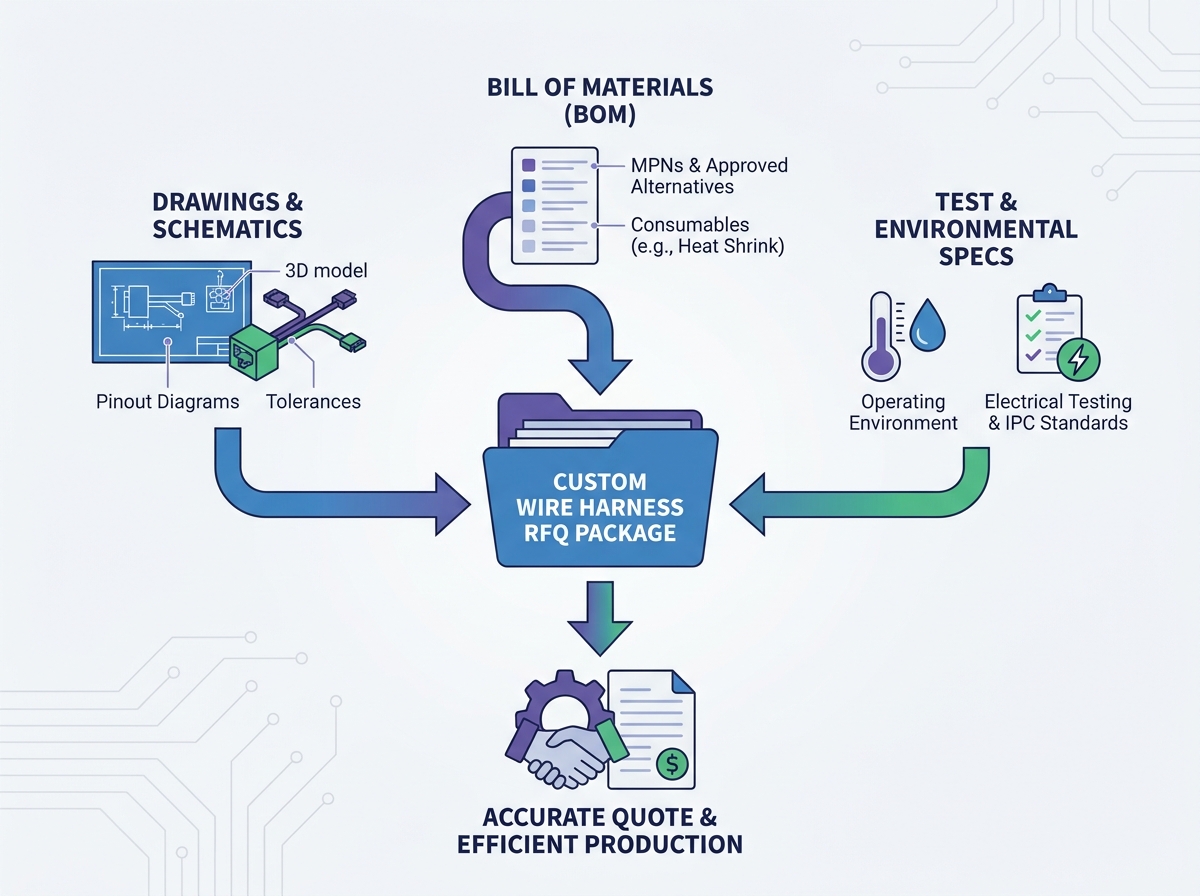
A comprehensive, standardized RFQ package solves this problem by minimizing vendor assumptions. It ensures apples-to-apples bid comparisons while accelerating your product's time-to-market. In this guide, you will discover exactly what engineering, procurement, and quality data you must provide. We outline the crucial elements needed to secure an accurate, actionable quote every single time.
Precision dictates pricing: An incomplete Bill of Materials (BOM) or missing tolerances forces manufacturers to estimate worst-case scenarios, artificially inflating quotes.
Environment drives materials: Specifying end-use conditions prevents component failure in harsh automotive or industrial applications.
Test parameters are not optional: Defining electrical and mechanical testing requirements upfront ensures compliance and prevents post-production quality disputes.
Volume impacts tooling: Accurate Estimated Annual Usage (EAU) allows vendors to recommend the most cost-effective automated tooling versus manual assembly.
Your technical drawings serve as the primary blueprint for production. Without clear visual and technical guidance, manufacturers cannot accurately estimate labor times or material yields. A robust drawing package should include several specific elements.
2D CAD Drawings and 3D Models: Provide clean, scaled diagrams. They must show accurate routing paths, breakout points, and overall lengths. 3D models help vendors visualize complex spatial constraints inside the final product enclosure.
Pinout and Wiring Diagrams: Detail exact point-to-point electrical connections. You must specify wire colors and gauge specifications (AWG). Clear pinouts prevent catastrophic miswiring during the assembly process.
Tolerances: Clearly define acceptable dimensional variances. Over-tolerancing increases manufacturing difficulty and drives up costs unnecessarily. Conversely, under-tolerancing risks installation failure on your assembly line.
Labeling and Markings: Specify requirements for wire identification. You might need heat shrink labels, printed wires, or barcode tags. These markings are critical for end-user installation and future maintenance.
Best practice dictates locking your drawings into a non-editable format like PDF for the RFQ stage, while also providing native CAD files if the vendor needs to extract specific geometric data.
A drawing shows how to build the product, but the Bill of Materials (BOM) tells the manufacturer exactly what to buy. When procuring a custom wire harness, your BOM must leave zero room for interpretation.
List exact MPNs for all primary components. This includes connectors, terminals, wire, and cable. Do not rely solely on generic descriptions like "2-pin connector." Generic descriptions force the vendor to guess, which inevitably leads to inaccurate pricing and potential performance failures.
Supply chain volatility is a reality we all face. Explicitly state whether cross-referenced or equivalent components are acceptable. Allowing substitutions can drastically speed up lead times and reduce costs. If strict adherence to the original MPN is required for compliance reasons, note this clearly on the BOM.
Include all secondary materials often omitted from preliminary BOMs. Engineers frequently forget to list heat shrink tubing, loom, zip ties, tapes, and mounting clips. These consumables add up. If you omit them, the manufacturer will have to revise the quote later.
Table 1: Essential BOM Components Checklist
Component Category | Required Information | Common Mistakes to Avoid |
|---|---|---|
Primary Connectors | Exact MPN, Manufacturer Name | Using generic distributor part numbers instead of MPNs. |
Terminals & Contacts | Plating type, Wire gauge range | Forgetting to specify gold vs. tin plating. |
Wire & Cable | AWG, Insulation type, Color | Omitting voltage ratings or specific UL styles. |
Consumables | Tubing shrink ratio, Tape material | Leaving consumables off the BOM entirely. |
Vendor material selection hinges entirely on where the assembly will live. Ambiguity here leads to rapid field degradation. You must frame the operating environment clearly so the engineering team can validate your material choices.
Vehicles present incredibly harsh environments. When designing a custom automotive wire harness, you must detail exposure to high vibration and extreme under-hood temperatures. Specify if the assembly will contact automotive fluids like motor oil, brake fluid, or transmission fluid. You should also require standard automotive wire grades, such as TXL or GXL, which feature cross-linked polyethylene insulation designed to withstand these exact conditions.
Factory floors demand different durability metrics. For industrial wire harness assemblies, specify parameters for continuous movement. Note the required flex-cycles if the assembly routes through robotics or moving machinery parts. Detail the need for abrasion resistance, chemical exposure limits, and specific IP (Ingress Protection) ratings to guard against dust and moisture.
Quality cannot be inspected into a product after assembly; it must be engineered and tested from the start. Your RFQ must explicitly state how the manufacturer should validate the final product.
Mandate 100% testing for continuity, shorts, and miswiring. Every single unit leaving the factory floor should pass a basic electrical validation using automated test boards. This is a non-negotiable baseline for quality control.
Depending on your application, basic continuity might not be enough. Define requirements for Hi-Pot (high potential) testing to verify insulation resistance and ensure no current leakage occurs under high voltage. Additionally, specify pull-force testing requirements to validate crimp integrity. Pull testing is destructive, so vendors need to factor these sacrificed units into their scrap rate pricing.
Specify the target build standard. The industry benchmark is typically IPC/WHMA-A-620. This standard establishes acceptable conditions for cable and wire assemblies. You must specify whether you require Class 1 (General Electronic Products), Class 2 (Dedicated Service Electronic Products), or Class 3 (High Performance/Harsh Environment Electronic Products).
Furthermore, note any necessary material or safety compliances required for the final product assembly. Common regulatory requirements include UL, RoHS, REACH, and CE. If the vendor does not know you need RoHS-compliant solder, they might quote standard leaded solder, invalidating the entire bid.
Chart 1: Testing Requirements Summary
Test Type | Purpose | Frequency |
|---|---|---|
Continuity Testing | Verifies correct pin-to-pin routing. | 100% of production units |
Short Circuit Testing | Ensures no unintended connections exist. | 100% of production units |
Hi-Pot Testing | Validates dielectric withstand and insulation. | Application specific (often 100% for high-voltage) |
Pull-Force Testing | Verifies mechanical strength of terminal crimps. | Batch sampling (Destructive) |
Engineering data only tells half the story. The commercial terms dictate how the manufacturer will set up their production lines and source materials.
State your Estimated Annual Usage (EAU) and typical release quantities. A custom wire harness quoted at 500 units uses vastly different tooling and labor strategies than one quoted at 50,000 units. Low volumes rely on manual hand-crimping tools. High volumes justify the cost of fully automated cut-strip-crimp machines, which drastically lowers the per-unit price.
Clarify if this RFQ is for initial First Article Inspection (FAI) prototypes or full-scale production. Vendors often handle prototypes in a separate quick-turn department. Knowing the project phase helps them allocate the right engineering resources to your quote.
Share realistic target costs and required delivery dates. Transparency here saves everyone time. It helps vendors quickly determine if they are a viable fit for your supply chain requirements. If your target price is impossible based on the BOM costs alone, a good manufacturing partner will flag this immediately and suggest value-engineering alternatives.
Even experienced procurement teams make errors during the RFQ process. Avoid these common pitfalls to ensure your quotes remain accurate and actionable.
"Reverse Engineering" Requests: Relying on a physical sample without supporting documentation introduces a massive margin for error. Wires stretch, colors fade, and internal splices remain hidden. Always provide formal drawings.
Hidden Tooling Costs: Failing to account for custom molding or specific applicator dies causes budget overruns. Ask vendors to separate the piece price from Non-Recurring Engineering (NRE) or tooling charges. This gives you a clear picture of your upfront investment.
Incomplete Revisions: Sending outdated drawings or failing to log revision histories leads to disaster. The manufacturer ends up quoting obsolete specifications. Always include a clear revision block on your CAD files and reference the specific revision letter in your RFQ email.
A rigorous RFQ process acts as the foundation of a successful manufacturing partnership. By providing comprehensive drawings, an exact BOM, clear environmental specs, and defined testing parameters, you remove guesswork and protect your bottom line. Precision upfront prevents costly revisions later.
Take action today by advising your procurement and engineering teams to audit their current RFQ packages against this framework. Standardize your documentation process. We highly recommend creating an internal RFQ checklist template to ensure no critical data slips through the cracks before you hit send.
A: Provide the mating component part number, current/voltage requirements, and environmental constraints so the manufacturer's engineering team can recommend a solution.
A: Yes, reputable manufacturers should have mutual Non-Disclosure Agreements ready to execute before sensitive IP (schematics and BOMs) is transferred.
A: Delays are almost always caused by missing data—typically incomplete BOMs, ambiguous tolerances, or waiting on pricing for unlisted proprietary components from tier-2 suppliers.


